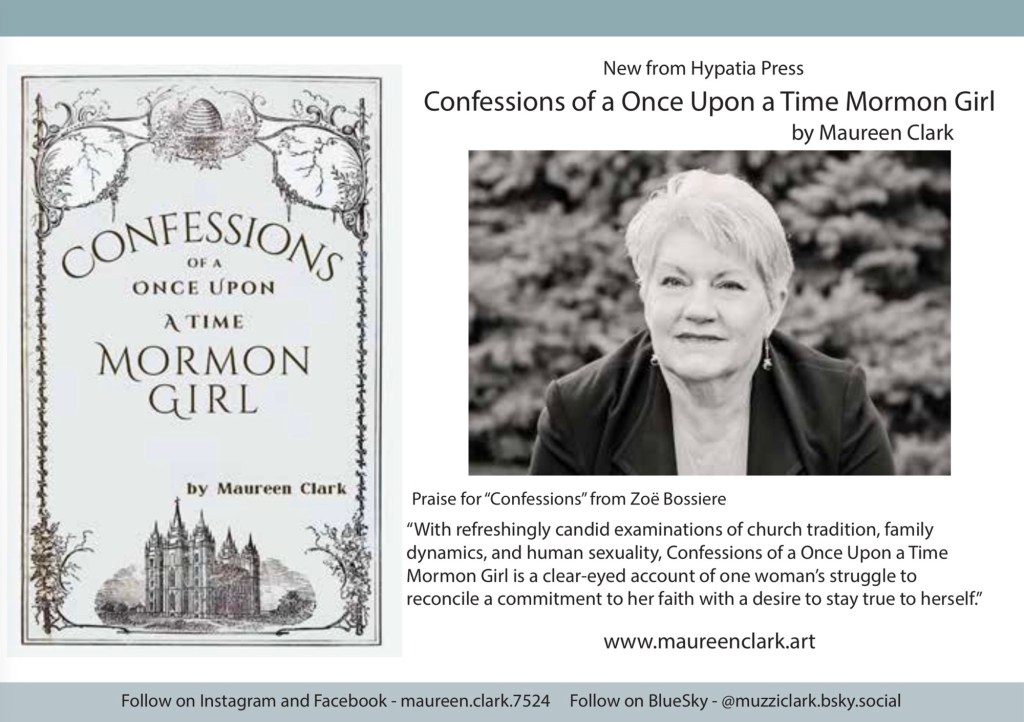
Confessions of a Once Upon a Time Mormon Girl. Maureen Clark. Hypatia Press, 2026. $13.99
Review By Kristy Crouse
Maureen Clark’s memoir, Confessions of a Once Upon a Time Mormon Girl, opens with her husband telling her that he’s leaving the Mormon church, a faith they were both born into and a foundational element of their nearly 30-year marriage. She is faced with two choices: to lean into her husband and their marriage or to lean into the church. She cannot do both. In the forty-three vignettes that follow (over nearly 300 pages), Clark reveals the stories that have shaped her life and will shape her decision. Her childhood in 1960’s Utah, falling in love with her husband during her first year in college, her marriage at nineteen, the births of her children, moves out of state and back, and her later-stage MFA.
Confessions is catnip-level irresistible to anyone who is curious about Mormon rituals and practices and wonders what happens inside a Mormon temple. Despite her vows of secrecy (and the truly disturbing consequences for breaking them), Clark shares details of her traumatic experience inside the temple on the eve of her wedding, what it is like to wear garments (the specific undergarments all Mormons wear 24/7), and the divided roles of men and women in the church. Clark also confesses some of her own secrets – from the innocuous love of her breasts as a teenager to something potentially marriage-shattering. It is the type of truth-telling that carries more than a whiff of personal risk.
At heart, Confessions of a Once Upon a Time Mormon Girl is a story about how one woman responds when the foundational fabric of her personal narrative – in this case, that she and her husband are a model Mormon couple – begins to visibly unravel. Clark calls to mind the role of stories in our lives, especially ones that are received through our families and communities, as she asks herself two universal questions: How did I get here? and Where do I go from here?
The title is a spoiler for her eventual decision, but Clark’s path is what is at the forefront. She takes all her beliefs back to the studs, reexamines the pieces, and reassembles the narrative with a hard-won clarity that only comes from time, experience, and a high tolerance for honest self-reflection. And it is not without cost. By the time Clark reveals her choice to leave the church four agonizing years after her husband’s decision, we understand what she is leaving behind. The inevitable pull of history, friendships, and community. The lifelong familiar.
We also understand how she got there. We meet Clark as a young girl who liked to dance naked when no one else was home and dreamed of growing up to solve mysteries and have adventures. We meet her parents – her police officer father who lets her help him nail new shingles on the roof and her mother who annotates the notecards for the speeches she gives at church. We learn of her love of licorice ice cream and the horror she felt when she learned what would happen to her body when she “matured.”
We have insight into what it is like to be a woman in her world – a “wife, mother, sister, and homemaker” who can be excommunicated by the men in the church. “Women didn’t lead the church; they supported their husbands and remained mostly invisible.” In Quilting Bee, she writes about a gathering of adult women at the temple and states “I learn from them everything I need to know about being a Mormon woman: try to be perfect, lie when necessary, giggle when no one else is listening.” Referring to her husband directly, however, the power dynamic does not appear to be as stark, especially when she describes the two of them as newlyweds as “two little lambs lost in the woods.”
Clark is a trained and practicing poet, and the language in Confessions is vibrant and visual. In the first Vermont Studios vignette, she writes “Staring out the window in Johnson, Vermont, into this extravagant green, drenched in the color of living, growing things; I am not one of them.” In Fact and Fiction, “Our roots are so knotted now, I wouldn’t know where to begin the untangling.” She describes one member at Sacrament Meeting as a “dandelion-gone-to-seed kind of man.” Clark also intersperses quotes and references from a variety of literary figures throughout the book, including Rumi, Modernist poet Hilda Doolittle, and the influential Hildegarde of Bingen.
True to title, Confessions of a Once Upon a Time Mormon Girl has several references to fairytales and many instances of fairytale language. Vignette titles include Chopping Wood, Peach Moon with Thorns, and Ever After and within the broader text we encounter mermaids, castles, dragons, fairy godmothers, a fairy godfather and a crystal ball (among others). Clark also relays several dreams and dream sequences that border on prophetic. Together with her love of nature, we see a woman who sees magic all around her and is open to multiple visions and versions of divine connection and experience. Confessions is not a story about a lack of faith, but a story about a woman wrestling with the components of an interpreted God. In the final vignette, Ever After, she adds “Fairytales are strange things. They have a static formula: good and evil, trial of faith and a happy ending. But that’s just the problem. That perfect ending happens before the real story begins. The real story is much more complicated and uncomfortable than what came before.” “The real work starts when the storybook ends.”
Although Confessions of a Once Upon a Time Mormon Girl could be labeled a tell-all, Clark’s skill at bringing to life her memories with physical details and internal reflections makes for a powerful tell-hers that is both a joy and heartbreak to read, and a stake in the ground to live a more clear-eyed life.