Morning Therapy
The cocoon safety zone of sleep into the apathy of the real world in the early hours of the night. Darkness is glued to the silent trees and the lantern dents in the texture of the streets like empty objects.
Things exist in the noumena and phenomena of the moment: a mixed bag of the moon rising in the winter fog between chimneys, half-walls, and hedges at street level, and trees transfixed above parked cars in unrealised shapes, on corners, under an awning, or behind the big trucks.
The day officially starts when traffic begins; first at random, buses, cars, and delivery trucks follow. Kids will hurry to school at quarter to eight in tiny steps, innocent eyes, and smiling faces.
I have to email an editor, but I’m not sure the written word is efficient today. I grew up thinking that a word is mightier than a sword, but things have changed.
It’s a magazine among hundreds of others, created to generate a profit in an obscure environment pretending otherwise, a literary work that will neither change the world nor entertain it, if that was the aim in a global competitive market. It is only a barcode item with an expiry date; once it is published, it is already déjà-vu.
Slowly, the world appears to be emerging from a hole into a buoyant balloon the moon draws around itself in its silver talc. It’s a Ziggy Stardust twinkling moment.
The sprawling space floats in the orange glow of lanterns diluted in the fog, and a silent police siren slices blue flashes on the buildings.
I take a red pill for blood pressure, a green pill for the heart, and a gulp of instant coffee, sour, sugar-free. Delete daily spam, check on rejection emails, wait for the first line.
The trickle-down effect of wealth comes from YouTube: in a study of Nietzsche, Alain de Botton discusses Proust, Rochefoucauld, Flaubert, Van Gogh, and a Lee Child podcast interview entitled Writing Can’t be Taught.
Alain de Botton: “We write because no one is listening.” He mentions Géricault’s Medusa, Le Naufrage. France’s frigate Méduse was involved in the slave trade and ran aground off the coast of Mauritania on 2 July 1816. A capsizing European continent in today’s metaphor, if you listen to the news. According to critic Jonathan Miles, the raft carried the survivors « to the frontiers of human experience. Crazed, parched, and starved, they slaughtered mutineers, ate their dead companions, and they killed the weakest.
Serious people leave their cell phones in another room when they do serious work, but not me. I don’t associate with emotions attached to “doomscrolling;” this is our destiny now.
Lee Child talks about Jack Reacher, the lone wolf doing good in a bad world. The “frontier feel of the big spaces” where things happen unbeknownst to the rest of humanity. Talks about the five pages he wrote to describe the two seconds a bullet stays in the air from a fired pistol. He justifies this by saying the reader is giving hours of his life to read what he writes, and he must not deceive him. “Those hours are gone forever,” he says, “and he must not feel he’s wasted them with you.”
What I have in mind to write about is nothing but the truth. It might be wrong to others. Scribbling is like taking an oath when you write “I do” in one sentence, but in the next, you change your mind.
I write longhand first; it will give me enough time to see the changes to adapt.
The “manif” and the proto-revolution occur at intervals in Paris when people are not happy. It happened in the past, and the world knows it as the French Revolution. It does not happen every day, but there is an undertow in people’s minds that leads them to throw Molotov cocktails in the streets. On the news, politicians blame left-wing “agitateurs,” as they call them in the local dialect. Woody Guthrie was an “agitateur” in the folklore of the United States, I remind myself, and Bob Dylan is a protest singer-songwriter. The song Ohio, CSN&Y, or The Wall.
The degree of violence measures the change the city is undergoing.
I am not really affected by it physically, but mentally it changed the perception I have of the Enlightened world, and I ask myself: is this where it is supposed to lead?
Of course, people think the neo-liberal corporate entities are buying the country, lock, stock, and barrel, as you say, and it makes the people not happy. We hear that some people want to franchise the Bible, for instance.
I am trying to get away from the mental dissonance this dichotomy causes in my perception of the world in general, since it did not reach its “end of history,” as some people claim.
I want to get away from it and find a psychological environment that is pleasing, one that is not constantly propagandised on the news like manufactured consent; hence my reference to the “self-made man” of Nietzsche and, to some extent, Spinoza, by that I mean the man who relies on himself and pushes the boundary of what he knows to discover the new, something like what Jean Piaget had in mind, but in the real physical world-experience and not just in books.
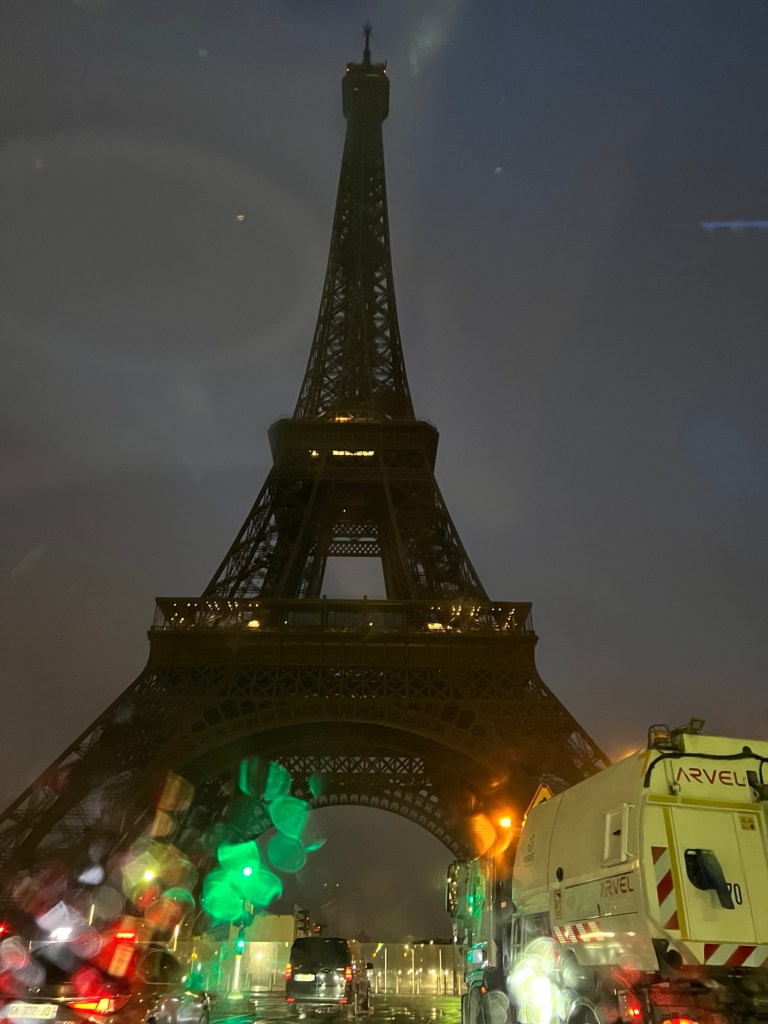
I don’t name the Eiffel Tower directly in the essay. The photo in the dark will foreshadow its negative “selfie attraction,” good only for a photo opportunity, and, with the electricity cut off, it will disavow the administration of the entire country.
Paris itself is beautiful, but you cannot live with the facades of the buildings or the gargoyles of Notre Dame. Paris is where the pitchforks defeated the Bastille. Look at the young people on the streets today, marching against the corporate media and the offshoots of Edward Bernays.
This particular photo immediately places the story in Paris, much like Coca-Cola or Chuck Berry’s “No Particular Place to Go,” a projection of a song in a free United States of America.
This photo will place the story in a countercurrent, or nonconformist position that persists despite police repression, only a week after the Pope’s rambling down the Champs-Élysées.
I would write something about the “manifestations,” but I don’t necessarily care about politics or politicians.
I think of a metaphysical Paris, the same way I thought of Manila, Puerto Princesa, and the Tulatulahan jungle where the manuscript unfolds with the natives who were my neighbours.
I am interested in Between Heaven and Hell by Hieronymus Bosch, which might measure the gap between the extremes, echoing in moments of doubt and uncertainty, like in Dellilo’s Underworld when Edgar Hoover looks at a reproduction of a Bruegel painting, The Triumph of Death, seen through the mood of the crowd during a baseball game as a sign of hope.
…..