Cavemen
……….I always think I’ll have more time—like the world and other people will behave according to the rate of my understanding or the readiness of my action. I’m half awake. The blackout blinds are closed. Our one cat Rocky mewls and grabs at the latch-style doorhandle to enter this dark abyss of lazy exhaustion. Carrie left early to work upstairs on the 9th floor. We’ve been avoiding each other since the miscarriage, but it’s hard to do that in only 600 square feet of an open floor plan. The damp air hangs thickly. A tiny car alarm forever modulates in my ear with no one to turn it off. I’ve had tinnitus for about six years. Whenever the space is quiet and peaceful enough, its persistent klaxon drills into me and my anxiety will begin to rise. I pray for a jackhammer, or disco nightclub, or the whirring of the refrigerator motor to drown it out.
My first coffee ends up on my shirt and in the sink because of a quick maneuver I make to empty my thermos while topping off the milk. I miss the bus and I have to text my class chat I’ll be a few minutes late. Today, I’m teaching Plato. The twenty students at the private college share my tiredness as they look up from phones and laptops when I enter the class in a flurry of satchel, coffee cup, and assignment folders.
“Alright, good morning, I’m very sorry about being late, I’ll make sure to give everyone a quarter bonus mark on their participation grade for today.”
Polite laughter from several students.
“If everyone wants to open their critical theory tomes to page 1300, let’s chat about Plato’s Cave,” I say and sit on the front of the desk. “We’re going to be considering the issues of essentialism, the inherent misogyny in his analogy, why some old dude from the 4th century BCE is useful for discussing modern day life, ways it might apply to things like the prevalence and problems of social media or how video games might be a virtual cave, and what we do about illusions or delusions in our lives that facilitate our worldviews.”
Class drags, but there are several great breakout discussions about how a cave and darkness can be good things and that analogies positing light against darkness reinforces unhelpful binaries. One student mentions that since the Greeks were misogynists, Plato’s conception doesn’t include women, and so the women must be off in their own reality not having to deal with his caves of illusions.
I’m collecting the latest essay assignments piled on the front desk when I get a notification on my phone. It’s an email from the administration. I slump down in the swivel chair seeing the “pink slip” as I roll halfway across the orange linoleum. I’ve once again failed to escape precarity. I hesitate to text Carrie the update. We still talk, but it’s brief and stilted. Text is somehow easier when we know any conversation will trigger an avalanche which will bury us before we can escape.
When I lug open the heavy door of our apartment, I can hear the light sound of The Car’s song “Drive”—the lyrics instantly sink into my gut—about not knowing who’s going to be the one to drive me home. I guess I’m driving me home. This is one of Carrie’s melancholic songs she listens to when she wants to meditate in grief. It happened after her mother passed. It’s been happening for the last few weeks since the meeting with our family doctor who explained the excessive bleeding. We were about to call our parents and let them know we were expecting, so close to the end of the first trimester—thank God we didn’t and can manage this without misunderstandings and overbearing concern.
“Hi.”
Carrie turns from where she’s looking out the window from the floral wingback chair at the black IKEA desk. Little grey and white Rocky purrs on her lap. The record rotates slowly on the turntable.
“I was laid off today.”
“Oh.”
I’m standing at where the long hallway terminates abruptly into the big open living room, unsure if I should sit down on the nearest chair or go back up the hallway to take my chores jacket off.
“I’ll do whatever I need to do to make money.”
“Are you okay?” Her voice cracks.
Alpha Dog, our other cat, curls into the room stretching and yawning. He finds his way to my leg for a hello-welcome-home pet and flops onto his back while slowly blinking his eyes.
“Um, I don’t know, I kinda feel like everything is going wrong right now, but I’m trying not to catastrophize.”
“Must be the blood moon eclipse.”
She points out the window with her slim fingers, hiding a sheepish grin. I smirk and let out a playful sniff of half-laughter as I bend down to scratch Alpha Dog under his chin. Our hesitant desire to enjoy each other again dissipates quickly. We’re quiet there for a bit. I’m not sure what to do next. The song ends and the needle clunks up and away. The emptiness in the room starts to fill with the ringing in my ear.
*
It’s Saturday evening and I’m at a small Irish pub up the street with my dad. Brooding within the dingy atmosphere hanging over us like a microcosmic night, I notice framed posters of Guinness endorsements next to encased shrines of Mary and Jesus. Maybe twice a year we go out like this to chat and catch up. We share a flight of scotch. We’re passing a tapered Glencairn glass of Japanese Nikka Whiskey back and forth taking sips.
“I have this memory of humping your leg while sleeping in bed with you and Mom,” I say. “I think I was probably like three or four or something. You just asked me to stop. But I remember it and I’m not sure if it’s real. Do you remember that?”
“No,” he says. “I don’t remember.”
I’ve been meaning to ask this for a while—afraid of his response, unsure if I’ve somehow fabricated the memory. His answer solves nothing. Every time we meet like this, I try to think of questions I want to ask him before he dies because once he’s gone. But I often forget his answers. Maybe I should record him? But that feels weird, like, encasing his voice in a prison. I find myself disliking my neediness—does he even want to remember? Do I really want to know? Is he avoiding the truth because it scares him? I wonder if I should divulge the miscarriage, if he’ll understand. Maybe my parents hid such tragedies the same way I am trying to?
“Mom sent me a link to your short story,” he says. “I’m glad it’s fiction.”
“Well, it’s autofiction, which means it’s heavily based on my own life and experience.”
He takes another sip and doesn’t respond.
“Hey, do you remember ever thinking of yourself as Métis when you were a kid?”
I ask questions to avoid his silence, holding onto the warped wooden table edge as if I’m about to fall into an ice crevasse. The server laughs with the white-haired couple at the bar behind us. How does he really feel about the story? I wrote about the day my family left the cult my siblings and I grew up in and which my parents were members of for twenty years. I wrote the story from my father’s perspective as a way to enter and explore his choices and emotions and how they might’ve connected to his abusive father.
“No, I never thought of myself as Métis back then.”
Doesn’t this mean I’m not Métis? It’s like fearing I’m not enough of a man. After I received my Métis card, I never stopped worrying if I was truly Métis. Our West Coast family had become so disconnected from our Winnipeg roots. Weren’t the Ontario Métis organization just handing out cards to anyone with the tiniest trace of ancestry?
When my grandparents moved out this way, they were the only ones who knew about that part of our past. So, no aunties or cousins met us at the door to explain, to share culture, to tell us our ancestry, how to introduce positionality through family names, or how our Métis history is very white.
“But you said that whenever you went out to Winnipeg to visit and saw your uncles on Grandma’s side, that you could see they were Indigenous.”
“Well, that’s not how we said it back then,” he grins, knowing he’s not supposed to say the problematic thing anymore.
“Yeah, but I’m just trying to understand how you identified and understood it. Like, Uncle Bobby says that your mom would sometimes say she was a proud Michif.”
“I don’t remember her saying that, but I have a bad memory.”
He says this often and I wonder if it’s a product of his emotionally, psychologically, and physically abusive father. I wonder about how a father passes on the shroud of patriarchy, how it slowly entombs a son with isolation, delusions of superiority, and impenetrability. Is this what made my emotions so unreachable? Is this why I’ve always felt this need to be unchangeable and stoic? Am I a container for some of his memories and identity, just as he was for his father? Was joining the cult a way to escape?
“I remember dancing with Grandma Philomena in the kitchen at the big blue house in Fort Garry, while Grandpa Abraham played fiddle and how she would grab me tight with my head between her big breasts and spin me around. She danced with all the kids.”
“I think I texted you a picture of that house last summer when I was back in Winnipeg.”
“Yeah, that’s the one,” he says. “Her and Grandpa ran a rooming house after he was injured in a horse carriage accident and couldn’t work anymore. He was always quiet though. Grandma did the talking.”
These are some of the hundreds of snippets my siblings and I have been piecing together for fifteen years. We know now my grandmother spoke French Michif, baked Bannock, lived in the historic Métis neighbourhood of Fort Garry, and that my grandfather met her while they both worked at a munitions factory during WWII. He would later take her away from her twelve brothers and sisters, and parents, and relations all over Winnipeg, first to Montreal and then moving on to settle in Vancouver. She loved to polka, which we now think was a way to disguise her jigging because my dad remembers her playing the Orange Blossom Waltz—a famous jigging song—and she grew up with her parents having regular Métis kitchen parties. Was she trying to recreate it in her own silent way? We know my grandfather got angry with her for teaching the kids “bad French” – likely the dialect of Michif she spoke which is a mix of Métis French noun phrases and Cree verb phrases. And along with his abuse, we presume he stifled her Métis identity so the kids wouldn’t know—perhaps to protect them; perhaps from shame.
By the time we learned we were Métis, my grandmother’s memory was lost to Alzheimer’s. At that point, she mostly just grumbled, cleared her throat, and repeated phrases like “Here’s mud in your peepers” and “Blah blah blah” and “You ol’ son of a biscuit box” while doing her word puzzles and drinking microwaved non-alcoholic Budweiser at the kitchen table across from my grandfather checking his stocks, bonds, and mutual funds.
“Were you sad when your mom died?”
“Well, yes, I think I was. I was.”
“I guess she had Alzheimer’s for a long time before she died, so you were probably already grieving,” I speak for him, just like I did in my short story.
“Are you still running?” he asks about my preparation for my first marathon, not insinuating about the way I’m dealing with my fragility and whiteness and our family history and my fear that Carrie and I don’t know how to talk anymore.
“Yep, training just started, it’s hard to stay motivated.”
“Makes sense for you,” he says and looks down at the glass. “I think this sip is yours.”
“Nope, I finished most of the last one, it’s your turn, go ahead.”
*
I’m running the Fishermen’s Trail in the North Shore Mountains with two friends, Jonah and Fred. We’re wearing headlamps and hoarfrost covers everything. It glistens and sparkles and it’s so pretty and for moments it looks like we could be in a cave. It’s about -1 Celsius and so dark that if we turned our headlamps off, we wouldn’t be able to see anything but the glitter. Fred is an ultramarathon runner who helped expand my running practice when I got back from Toronto after my MFA. Now I’m trying to run a marathon before I turn forty.
Jonah is doing a post-doc at UBC in environmental philosophy and recently divorced; Fred dropped out of his masters of theology to become a carpenter and his wife recently gave birth to their first child. I am very close to both of them, but Jonah recently moved back to Vancouver and has been getting closer to Fred and I’m kind of jealous.
“I’d really like to get to around a V5, but I’m finding this plateau at V4 to be really tough to get past,” Jonah says. “There’s something in the technical nature of the positions, or the raw finger strength, or maybe my overall body strength, or, it’s likely all three of those.”
“Yeah, using the fingerboard will help a lot, it’s actually better than just climbing,” Fred says. “It’s so hard to build that strength from going through standard bouldering moves.”
“Are you good to go to the indoor climbing gym on Saturday again?”
The crisp and clear stars stretch out like diamond dust in the absence of light pollution.
“Yeah. And I’ve been thinking. I’ve been looking at some more technical daylong runs using the Baden-Powell trail, where we can maybe go for twelve hours or so and hit several peaks, where we might need to scramble. But I’ve also been looking at some basic alpinist trails. I wonder if we’re actually good candidates to approach some more basic mountaineering.”
“What’s that thing you said the other day, Jonah?” We’re near the end of the run; my quads are throbbing with lactic acid. I want to get inside this conversation. I want to speak my way into what I can’t participate in because I don’t think I can catch up since they are years ahead in climbing. “About exercise modalities creating a different way of seeing the world?”
“Oh yeah, like, how climbing as a kinesthetic art practice that creates certain ways of orientation because of the verticals, and the need to manage one’s weight, and moving your body using almost entirely core strength, like the core is the mind which relates its own way of thinking through the world.”
We’ve finally reached the edge of the trail which is a roundabout surrounded by beautiful North Vancouver custom-built homes: bevelled cedar siding, massive glass windows, exposed river-rock chimneys. There’s one weak streetlight at the edge of the wooden bridge that leads into the forest. In the middle of the road, we’re doing cool-down stretches under the dim pool of glowworm yellow.
“Those YouTube kettlebell exercises have been great for my stabilizers,” I say to Fred.
“Oh yeah, good good, what else are you doing in the gym for training?”
“I have a weights day where I do a bunch of things like deadlifting.”
“Oh yeah, deadlift, you’ve gotta be careful with that, right?”
“Yeah, I found a step-by-step guide online, like twenty pages, and I followed it pretty intensely with light weights before getting more serious, but I definitely twinge my back sometimes.”
“Deadlifting is more like having your back straight,” Jonah ask-states.
“Yeah, like—” I get into my deadlift stance, going through the steps— “Your legs aren’t as wide as when you’re doing squats, and you’re supposed to hold in your breath.”
“Oh?” Jonah considers. He goes through the posture thinking through this. “Yeah.”
“With squats, you’re always breathing out on the lift,” Fred adds in a half-questioning tone.
“Look at us all bro’ing out about weightlifting,” Jonah says.
We laugh. None of us want to identify ourselves with a “weight-lifting” bro type, or bros in general, but we all love exercise and athletics and nerd out about it. We’re also conflicted about machismo, what it means if we get too close. How puffing out our chests and punching each other playfully would be ironically funny, but also suggest we like it. The deeper I dig into myself and my masculinity, the more fragmented I become. Like I’m lost in myself. Like, I’m Plato’s actual cave, but also the prisoners in that cave; and also, those creating illusions on the wall, and the sun outside, and the person who gets free, and sees the sun and comes back, and is fraught with the decision of whether to put the chains back on or try to release the others.
In the car on the way back into the city, Jonah mentions this documentary he showed to his environmental justice class. The newly installed sterile white LED streetlights sway over top of us as we buzz along in my Honda Civic hatchback.
“The Kogi train their holy men, called mamas, by keeping them in the darkness of a deep cave from when they’re about seven months to when they reach maturity and become a ‘man,’ something like nine years old.”
“Hmmm, we were just talking about Plato’s Cave in class today,” I say.
I catch myself thinking about me and Carrie’s unborn child and how just a few months ago it was gestating in her womb. I haven’t told anyone yet. I want to tell Jonah, but my intellectualizing works like a defence mechanism, preventing further access to the emotions stuck in my chest—our little unborn boy.
“They live on a sacred mountain in the Sierra Nevada de Santa Marta chain they call the heart of the world and believe that all the rest of us, anyone who’s not Kogi, came from this heart. They consider our societies the “younger brother” and that all our industrialization is killing that heart.”
The car shakes. A loud clank rattles the undercarriage. Something shoots out behind us and I catch the sparking object in the rearview mirror. I slow down but we’re on the Iron Worker’s Memorial Bridge where many men fell to their deaths when it collapsed seventy years ago, and there’s nowhere to pull over. I smell smoke. Am I going to die? Yes.
We pull over just as we get off the bridge and someone honks loudly shooting passed.
“Go fuck yourself,” I shout.
Jonah looks under the car with his phone flashlight. I pop the hood and start examining the engine. There’s a distinct smell of burning which goes away after a few minutes.
“Tires are fine, nothing’s on fire, no visible damage. I’m okay to keep driving.”
“Yeah, looks all good to me,” he says.
We pick up the conversation again but my mind is elsewhere. I drop Jonah off at his basement suite and we hug and say goodbye and I take a second kicking a stub of grass that grows over the edge onto the sidewalk. On the way back to my apartment the stuffy quietness of the car elicits my tinnitus, so I turn on the radio and catch the tail end of “Drive.” Weird. It’s too weird. Must be the blood moon eclipse.
The dark apartment blurs my eyes as I push past the heavy door.
“Hello?”
No response.
I flick on the hallway lights and see a few cardboard boxes at the end of the hall. No cats come to greet me. On the island, there’s a folded yellow slip of legal pad paper.
Hey,
I’ve packed up most of my stuff and taken what I could fit in my car. I’ll be back later this week to get the rest. I’m sorry, I just can’t be in this relationship right now. Let’s talk in a couple of months. Maybe we can figure out something. I just need to be completely alone for a while. I’ll be at my Nona’s.
I lay on the washed green bamboo sheets Carrie must’ve put on the bed before leaving. The darkness encompasses me but the blinds are up and the streetlights glare bright and hard and sharp. The half-empty apartment is so peaceful. I start noticing the ever-present car alarm going off in my ear getting louder and louder. It’s hard to focus on anything else. Up and down, up and down, up and down, up and down. I plug my ears for half a second of relief before it comes back louder. I push my thumbs around my jaw. I massage my temples and do TMJ exercises. When it’s bad like this, I imagine jamming a pencil into my ear. I want to dig in and claw out the noise. Turning on my side, I take one of the pillows, clamp it on my right ear and weep into my rough hands scratching at the hot tears on my cold cheeks, wishing I could listen to Carrie snore.
…..
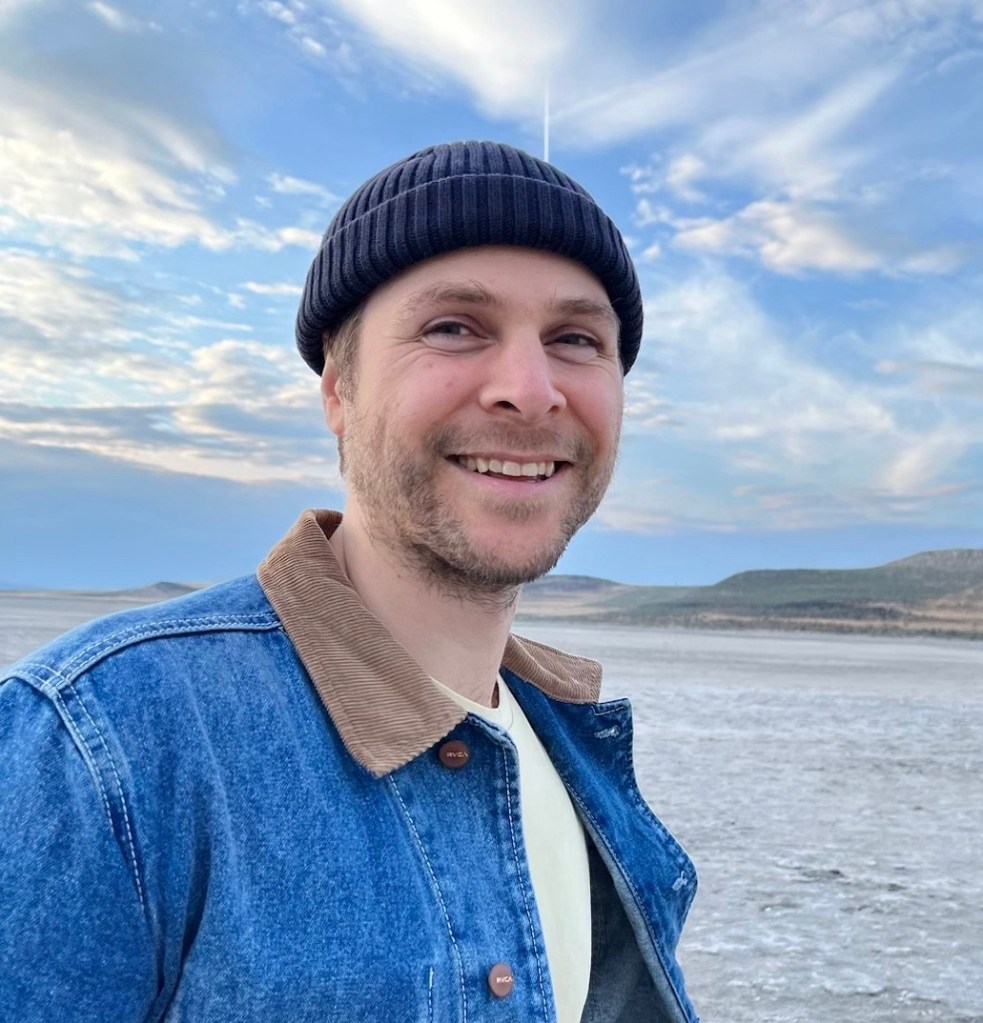
Jonathan Bessette‘s writing is informed by many practices, including astrology, gaming, gardening, and anarchism. He lives in the unceded and traditional territories of the Musqueam, Tsleil-Waututh, and Squamish Nations, so-called Vancouver. He’s a founding member of Held Magazine and has published poetry in TCR, Ampersand Review, and CV2, nonfiction in Adbusters and Quill and Quire, and fiction in The Antigonish Review and Carte Blanche.

