Visionary and Elegiac Poems in Elegant “Rucksacks”
Review by Tom Goff
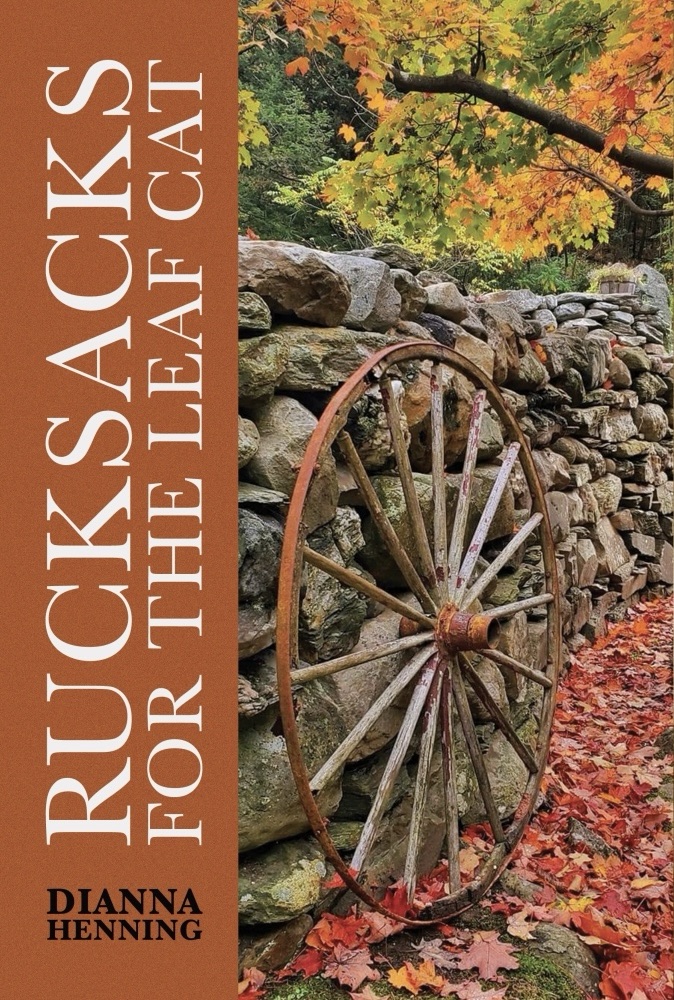
Dianna Henning. Rucksacks for the Leaf Cat. 84 pp. $22.99. Finishing Line Press, 2026.
I first encountered Dianna Henning’s great abilities as a poet when reading her “The Joy Whistler” in The Sacramento Anthology: 100 Poems of 2001. In that poem, the married speaker suggests—with delicacy and wit—how even the most intimate marital partner may give only a revealing glimpse of, say, an outdoors boyhood; whistling is the future husband’s spontaneous expression of joy, reenacted in much laterdomesticity. Several collections later, Henning’s powers are amply on display in this new gathering. Take, for instance, “The Leaf Cat”:
If you stare at something long enough it assumes a life all its own.
Even the wind carries a child in a rucksack.
The child’s name could be Leaf,
emblematic of green, its mixture of yellow and blue.
Our tortured world loves green,
its promise of better times.
Oh, to be green in the long night of terror.
Meanwhile, the leaf-cat reclines on a padded porch chair.
The cry in its throat is red.
Next, in “The Star Drum,” we read:
Who’s astonished by the way
stars smell like communion wafers?
Already the galaxy’s priests
have rounded up the runaways.
Whoever has ash on their tongue
is doubly blessed. There once
was a drummer boy
whose drumstick had eyes.
Every star he ever paddled
carried a scent of water.
Whoever speaks in stars
has a steel drum for a heart.
Percussion is a matter of attunement.
These two opening poems in Rucksacks for the Leaf Catblaze uncharted ventures into a post-modern surrealism as seen “through a glass, clearly.” “The Leaf Cat” takes everyday optical illusions as its premise (“If you stare at something long enough it assumes a life all its own”), yet the images in the poem come charged with ambiguous, transformative solidity. Is the “leaf-cat” on the porch chair a real cat with tinges of orange-red in its fur or a heap of accumulated dead leaves? Even putting names to such surmises doesn’t diminish the poem’s eeriness.
As we’ll see throughout “Rucksacks for the Leaf Cat,” the avant-garde tendencies in Henning’s poetry often face both boldly forward into the “undiscovered country” just ahead and gently backward into the grand tradition of English-language poetry. “The Star Drum” baffles at first, with its assumption that stars (and communion wafers) have distinctive smells—yet, don’t our distracted senses tell us the outdoors in which we scent the stars indeed emanates pungent, suggestive aromas?Or that the starlit skies whisper to us of communion?
As Henning’s collection proceeds, we perceive turns into darkness, moments of grieving for someone lost, never maudlin. Here is “Already”:
…..
Touch me in the night of my body.
Where the wind can’t get in.
Where layered rose petals turn magenta.
Already I have loved you, have left you.
What remains is that which cannot be spoken.
The other day I heard a wind speak your name.
The willow branches seared my arm
as I walked where we’d once walked.
I remember you because I cannot forget.
Already my loneliness is dark with grief.
Nothing remembered that can’t be retrieved.
Your hand rested in mine in my sleep.
Already my body is a homecoming.
I’ll wait for you on the front stoop near the lilacs.
In the distance your footsteps grow louder.
……
In its intense yearning for an absent lover, this poem—for me—harks back to such classic poems as Ezra Pound’s “The River-Merchant’s Wife: A Letter,” with two clear differences. First, the physical absence of the loved one here seems irrevocable. Second, paradoxically, the tersely worded sentences imply vacancies that might be filled (in the speaker’s wishful brooding) via beyond-the-grave or from-the-Bardo replies by the lost one.
In other poems, urgent questions nag at the narrator, as in “The Succulent”:
Was it the slope of his shoulder
as he slept, how the vulnerable spine
becomes stem to some exotic fruit
that enticed me to burrow into him,
or the way the pupil floats underneath
the eye’s foreskin, one thing
resembling something else? We spat,
and I’d shouted the irreverent,
I want to split. Running away
had been my fait accompli,
but recently its appeal lessened,
realizing I tussle mostly with myself.
Instead of running off, I closed
the space between us, my breath,
soughing down his back. “You’re
perfectly imperfect,” I remind myself.
Even panic surfaces, recounted with retrospective firm control, as with “In the Aftermath of Afterwards”:
The leash snaked home behind the dog. But
my husband out walking our Samoyed was missing.
(Who wonders if darkness is evaporation?)
Lily, spooked, sped inside, shook off snow,
her tongue long as a man’s necktie,
our Trailblazer flashlight, nowhere in sight.
Where was the man who’d walked her?
Sammy’s tail fanned the room. She barked.
I said Quiet, where is he? Fear
a prelude to the unimaginable. Perhaps
his heart gave out and he’s a heap in a snowbank.
Nighttime drivers can’t easily discern
one shadow from the next. He might
have looked like rabbit brush or perhaps
a friend picked him up, took him for a beer.
I lock Lily in her metal crate,
slip on my jacket, walk out his route.
The wind slaps my back, I punch it back.
Me screaming out his name
renders zilch—blizzardly snow, dancing
dervishes. I hightail it home. The man
I’d looked for opens the door. Where
the hell have you been, he asks. Adding,
“I know you like to make snow men,
but really, darling, in this weather?”
Implicit in Henning’s collection are influences upon its lyricism and firm tonal command: Native Americans, Sappho or Anna Akhmatova, all mentioned in epigraphs or dedicatory acknowledgments. Here is “Sappho 1,” the first of two poems directly invoking the Greek lyricist:
You tasted moon flesh,
swallowed its sweetness,
settled back on feathered pillows
to watch stars float
across night’s benevolence
Cleis, why leave me with such sorrow?
*
Now even candlelight sucks
as it gloms onto the wick
*
Since you left, I’ve learned
to enter rock with my breath, to bury
that old bone grief
The two “Sappho” verses, unpunctuated like fragmentary verses from the poet of Lesbos, directly follow “The One with Violets in Her Lap,” in which both the title and the musical flow are Sappho-engendered, but with eerily inserted imagery of clock and playground swing. I have no fault to find with this assemblage of graceful, visionary, often tough-minded poetry, and will conclude by quoting Henning’s “The Opening World,”near the book’s end:
Once thirst is quenched,
where do I go into the opening world?
(There’s no place to turn me away.)
If my feet sing as I stroll
do not look strangely upon me.
Who could have known
that my feet would sip from streams,
or that my toes would play tag in the shoe of traveler earth?
The valedictory note in the opening line, “Once thirst is quenched,” intimates that, for the vatic, far-seeing poet, much more than thirst has been quenched. An almost-revenant mind addresses us, concerned for how she might be valued at life’s end, while other layers of the psyche retain serenity and pride at having lived and written. Dianna Henning’s Rucksacks for the Leaf Cat fully earns and justifies that pride.
…..
Tom Goff recently retired after almost 30 years as an instructional assistant for the Los Rios Community College District. His poems have appeared in several issues of Voices (Cold River Press), Fire and Rain: Ecopoetry of California (Scarlet Tanager Press), Tule Review, Poet News, Sacramento News & Review,Shakespeare Oxford Newsletter, Spectral Realms (Hippocampus Press, NY), FLC’s The Parlay, The Sacramento Anthology: 100 Poems, and Late Peaches. Tom has reviewed poetry books for Poetry Flash, Poet News, and Jacket Magazine. He plays trumpet with Auburn Symphony, Camellia Symphony, and Golden State Brass….……
…..
To order: https://www.finishinglinepress.com/product/rucksacks-for-the-leaf-cat-by-dianna-henning/
 The Paddock Review