(nearsighted)
I reject myopic at the eye doctor’s office.
I appreciate my eyes are aging: I squint
at smaller neighborhood street signs, blame
color contrast. (Know I’m breaking down.)
But words matter, and while I reflect on
light bouncing off objects, the electrical
signals my brain interprets the light to be,
vanity has me holding my creativity in high
esteem: even with my astigmatism, I would
discern patterns (and narratives) in the old
Magic Eye puzzles. Sight is thought to be
humans’ strongest sense, how we engage
with our worlds uniquely. My lenses help
refract light making its way to my retinas,
washing my landscape in watercolor hues:
today, muted by rainclouds and brightened
by daffodils in the greening yard. Water-
soaked leaf litter hints at a storm brewing,
and I tuck my grandmother’s umbrella,
blue with yellow flowers, under my elbow.
When I focus on just the next moment, there
is a warm feeling of control: as I shift my attention
to the horizon, everything’s less clear, less known,
and that haze, what’s unexpected, sits curled
in a cold, fetal ball in my stomach’s pit.
……
This poem is from the book Hindsight 20/40 by Liz Whiteacre (Finishing Line Press), and can be found at https://www.finishinglinepress.com/product/hindsight-20-40-by-liz-whiteacre/
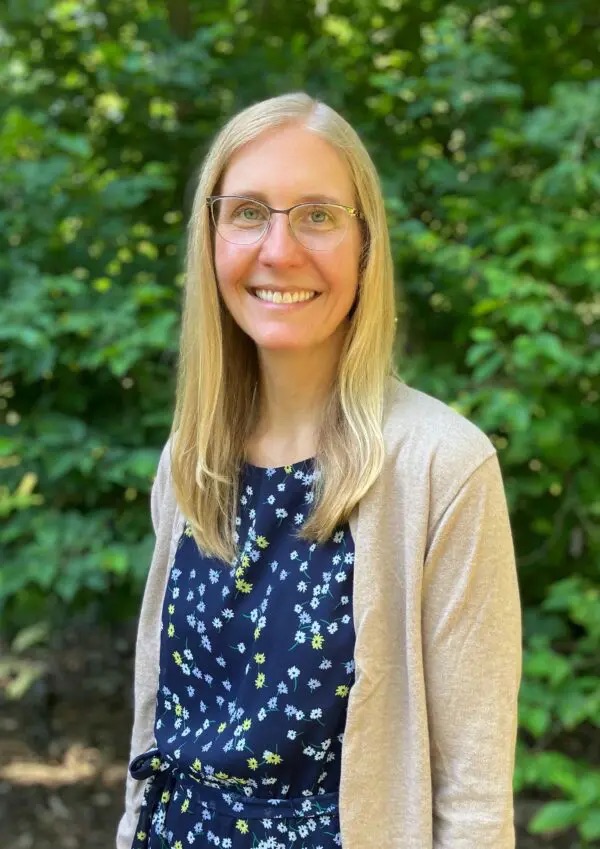
Liz Whiteacre’s poetry explores accident, disability, aging, and wellness. She is the author of Hit the Ground (2013) and it could account for the panic (2025). Her poems have appeared in Wordgathering, Disability Studies Quarterly, Kaleidoscope, Breath & Shadow, Flying Island, and other publications. Whiteacre is an associate professor of English at the University of Indianapolis. She teaches writing and publishing there, as well as advises Etchings Press.
 The Paddock Review